Showing posts with label sports. Show all posts

Monday, October 21, 2024

THE MOST USELESS JOB IN SPORTS BROADCASTING

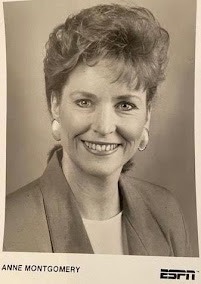
 from Anne Montgomery


I spent about 15 years as a sports reporter. I’d like to say things are getting better for women in the field, but there’s a lot of room for improvement. 

I was a sports reporter for about 15 years. I spent about ten years in television, where I worked for five TV stations – anchoring and reporting – and about five years as a print journalist. I mention this because I pay attention to media sports positions, having given a large chunk of my life to that world.

Back when I wormed my way into the sports world, there were few other women. In my daily interactions, I almost never dealt with others of my gender. But, as more women joined the ranks, I truly believed that eventually the field would become more welcoming.

Sadly, that hasn’t happened.

Some of you may be thinking, “Gosh, Anne. You’re wrong. There are women sportscasters all over the place.”

Well, technically there are more women working in sports media today, perhaps because there are so many more broadcast outlets when compared to the days when most towns had just three TV stations and cable and the Internet didn’t exist. A handful of women have even had the opportunity to share their expertise in the booth, doing play-by-play and color commentary. But the numbers are dismal when compared to all the sportscasting jobs out there.

Kate Scott has done play-by-play for the Pac-12 network.  In The Ringer article “Where Are All the Women in Play-by-Play Broadcasting?”, Scott called the lack of women in the field a numbers game.


Most sportscasting jobs, especially the ones in color and play-by-play, are still held by men.

“If there’s 10 guys applying for a job, and one woman, there’s more of a possibility that a guy’s going to get hired, just strictly because of the numbers of it,” Scott said. “Plus, many of the people in charge are men, who may be more likely to hire other men for the job. And on top of all of that, women need to have champions in order to succeed in these roles, or people willing to take the risk. Hiring a woman to call a sports broadcast still goes against the industry norms and often requires taking a chance on an unknown. But recently, albeit slowly, that’s starting to change.”


When women do get a shot at the booth, it’s most often to call games where the participants are women.

Most often, the women called on to work in the booth are covering sports with female athletes. I’m not complaining here, just stating a fact. The logic seems to be that since women play basketball, for example, giving them a shot in the hoops booth isn’t that great a stretch. But women who call baseball, football, or ice hockey – especially at the male professional level – remain a rarity.

And when networks do decide to give women a chance, a closer look reveals they don’t have much faith in the viewing public’s willingness to listen. Remember the Thursday Night Football game when Hannah Storm and Andrea Kremer – two women who’ve been in the field for decades – became the first female team to call an NFL game? Nice! I thought! It’s about time. But then I discovered that that broadcast was an alternative feed, one that viewers had to select instead of the “normal” booth team that featured Joe Buck and Troy Aikman. That clearly showed that the folks in charge aren’t quite sure the viewing public can handle women in the booth.


Sideline reporters like Erin Andrews are often asked to be nothing more than a pretty face.

That leads us to the most useless job in sportscasting, one which, perhaps not surprisingly, is often held by women: sideline reporting. There is absolutely no reason, in my opinion, for this job to even exist. Sideline reporters rarely talk about anything but injuries. It would make more sense to have a medical professional manning the sidelines than a sports reporter. “Now let’s go down to Nurse Becky on the field!” And I’ve watched entire games where the guys in the booth only go to the sideline reporter a couple of times. So, what’s the point? I sense the position was created just so the networks can brag about how inclusive they are. “Look! Wow! We’re letting a woman step onto the field. Aren’t we great!”

Here’s the thing. Sports broadcasting is not rocket science. So, can we move along here? Open those doors and give some women a chance.

Really, what would it hurt?

Here is a brief peek at Anne's latest release.

Bud Richardville is inducted into the Army as the United States prepares for the invasion of Europe in 1943. A chance comment has Bud assigned to the Graves Registration Service where his unit is tasked with locating, identifying, and burying the dead. Bud ships out, leaving behind his new wife, Lorraine, a mysterious woman who has stolen his heart but whose secretive nature and shadowy past leave many unanswered questions. When Bud and his men hit the beach at Normandy, they are immediately thrust into the horrors of what working in a graves unit entails. Bud is beaten down by the gruesome demands of his job and losses in his personal life, but then he meets Eva, an optimistic soul who despite the war can see a positive future. Will Eva’s love be enough to save him?

Praise for Your Forgotten Sons

“Although a defty crafted work of original fiction, “Your Forgotten Sons” by Anne Montgomery is inspired by a true story. An original and inherently interesting read from start to finish, “Your Forgotten Sons” will prove to be an immediate and enduringly appreciated pick.”  Midwest Book Review

“This was a quick, riveting read that really challenged me to think differently about our servicemen and women, especially those who take on the jobs that don’t get heroically depicted in the media or news…I really highly recommend this book to anyone that is looking for a different take on American history. I left it with a newfound appreciation for the unsung heroes.” Bekah C NetGalley 

“This is the truth. It’s gritty and painful and bittersweet – and true.  When you think you’ve read every perspective of WWII, along comes Bud to break your heart.” Bridgett Siter Former Military Reporter

“Anne Montgomery writes a strong story and I was hooked from the first page. It had a great concept and I enjoyed that this was inspired by a true story…It was written perfectly and I was invested in the story. Anne Montgomery has a great writing style and left me wanting to read more.” –  Kathryn McLeer NetGalley 

Available at Amazon, Apple Books, Barnes & Noble, Google Books, and Kobo

Anne Montgomery
has worked as a television sportscaster, newspaper and magazine writer, teacher, amateur baseball umpire, and high school football referee. She worked at WRBL‐TV in Columbus, Georgia, WROC‐TV in Rochester, New York, KTSP‐TV in Phoenix, Arizona, ESPN in Bristol, Connecticut, where she anchored the Emmy and ACE award‐winning SportsCenter, and ASPN-TV as the studio host for the NBA’s Phoenix Suns. Montgomery has been a freelance and staff writer for six publications, writing sports, features, movie reviews, and archeological pieces.

When she can, Anne indulges in her passions: rock collecting, scuba diving, football refereeing, and playing her guitar.

Learn more about Anne Montgomery on her website and Wikipedia. Stay connected on Facebook, Linkedin, and Twitter.


Monday, March 21, 2022

Officials in the Booth?

Really, it was all my idea.

by Anne Montgomery

I became a sports official to learn about the games so that I might become a competent sportscaster. It seemed like a good idea, and yet, during my 15-year reporting career, I never met any other officials who became broadcasters.

A long time ago, back when I hoped to earn a paycheck in front of a TV camera, I had what I thought was a moment of brilliance. Why, I opined, wouldn’t TV networks want to hire sports officials and put them in the broadcast booth? The idea seemed like a win-win.

Of course, I was a tad biased. I had taken five years and learned to officiate five sports: football, baseball, ice hockey, soccer, and basketball. All with the hope that my new-found on-field expertise might wrangle me a job as a sportscaster. While blowing whistles and calling balls and strikes did eventually help me get my foot in the sports journalism world, I never in 15 years as a reporter meet any other broadcasters from the officiating ranks. 

When I was a SportsCenter anchor at ESPN, I suggested it might be a good idea to put former officials in the broadcast booth. My colleagues thought I was crazy.

Fast forward to today, where former officials are now miced up and sharing their thoughts on calls with the viewing public. That makes me want to hop into Mr. Peabody’s Wayback Machine and confront my old colleagues at ESPN.

“It would be great,” I explained in the newsroom back in 1990. “You could put officials in the booth and they could explain why certain calls were made."

Crickets.

 "You know, clear up confusion for the viewers.”

My remarks, as I recall, were met by head shakes indicating that I was certainly out of my mind. Who would ever want to listen to sports officials speak? They intimated. 

Fast forward thirty years and there they are, with the NFL leading the way. Former officials and now rules analysts Mike Pereira, Dean Blandino, and Terry McAulay, among others. Then there’s Gene Steratore, who along with his 15-year NFL career spent 20 years calling college basketball games and is now an analyst for both sports. 

The question is, what took the networks so long? Sports rules are complicated. Don’t believe me? Ask someone to explain what constitutes a catch is in football. Or the reasoning behind and execution of an infield fly in baseball. Or the difference between a foul ball and a foul tip. Or when icing is waved off in hockey. Or how to tell a charge from a block in basketball. Or what constitutes traveling. Oh, wait. No one calls that anymore.

While fans might better understand their favorite sports by listening to former officials in the booth, maybe they're happier just arguing about the rules. 

Anyway, if you don’t believe me, pick up a rule book. Just read one page. I dare you. Rules and their corresponding diagrams can sometimes look like hieroglyphics with descriptions written by folks from MENSA. So why not hire people who study those books for a living? Then they can dumb down the rules to make them more digestible to the viewing public. 

Then again, many fans thrive on controversy and arguing about calls is high on their list of entertaining things to do. Maybe if they actually understood the rules, some of the fun might be drained out of sports fandom. 

As a purist, I think it's better to truly understand the rules, but since I spent four decades as an amateur official, I'm clearly more than a little biased.

Here is a peek at one of my women's fiction novels. I hope you enjoy it.

A woman flees an abusive husband and finds hope in the wilds of  the Arizona dessert. 

Rebecca Quinn escapes her controlling husband and, with nowhere else to go, hops the red-eye to Arizona. There, Gaby Strand – her aunt’s college roommate – gives her shelter at the Salt River Inn, a 1930’s guesthouse located in the wildly beautiful Tonto National Forest. 

Becca struggles with post-traumatic stress, but is enthralled by the splendor and fragility of the Sonoran Desert. The once aspiring artist meets Noah Tanner, a cattle rancher and beekeeper, Oscar Billingsley, a retired psychiatrist and avid birder, and a blacksmith named Walt. Thanks to her new friends and a small band of wild horses, Becca adjusts to life in the desert and rekindles her love of art. 

Then, Becca’s husband tracks her down, forcing her to summon all her strength. But can she finally stop running away? 
Amazon Buy Links E-Book - Paperback

Anne Montgomery has worked as a television sportscaster, newspaper and magazine writer, teacher, amateur baseball umpire, and high school football referee. She worked at WRBL‐TV in Columbus, Georgia, WROC‐TV in Rochester, New York, KTSP‐TV in Phoenix, Arizona, ESPN in Bristol, Connecticut, where she anchored the Emmy and ACE award‐winning SportsCenter, and ASPN-TV as the studio host for the NBA’s Phoenix Suns. Montgomery has been a freelance and staff writer for six publications, writing sports, features, movie reviews, and archeological pieces.

When she can, Anne indulges in her passions: rock collecting, scuba diving, football refereeing, and playing her guitar.

Learn more about Anne Montgomery on her website and Wikipedia. Stay connected on Facebook, Linkedin, and Twitter.

Monday, September 21, 2020

Fighting About Fouls at ESPN

by Anne Montgomery

In a perfect world, sportscasters would get long leisurely looks at the highlights they use in their live broadcasts. They’d get to rehearse a few times, using their own verbiage to describe a sweet double play or a long touchdown run.

But in the real world, there are times when sportscasters don’t get to view the video prior to a broadcast. Imagine trying to look pleasant, sound authoritative and knowledgeable, and having to describe a previously-unseen set of highlights, while someone is yelling in your ear. Now, try to do it when the highlights are poorly written.

At ESPN, there was a group of workers called PAs: production assistants who spent almost all their time observing games and picking plays for SportsCenter broadcasts. I’m sure to rabid sports fans the gig sounds like having one foot in heaven. A PA would be assigned a game, they’d sit back, watch, and pick three or four highlights. All they had to do was get the plays edited and write a script explaining what was happening in the shots they chose. A final score would then be added. That was it.

Generally, the PAs would appear at the anchor’s newsroom desk before the show and hand over their version of the script. I would always go view the video, make my own additions to the copy, and thank the PA. Beautiful.

However, sometimes there were late games that were still in progress during the SportsCenter broadcast. It was one of these contests and a subsequent set of highlights I received that got me into a bit of a pickle.

One evening, a sheet of game highlights was slipped onto my desk just as the crimson camera light blinked on. I smiled and read the intro. Then, as the video rolled, I eyed the script with my left eye and focused on my desk monitor with my right. (Not really, but it sort of feels that way.) And there it was, a screaming line drive hit into the first row seats, beaning a spectator squarely on the noggin. I read the script and immediately knew there’d been a mistake. The copy read that the fan had been hit by a foul tip. I knew this was impossible, but the next play quickly appeared and I had no time to right the wrong.

It wouldn’t be until the postmortem – the meeting that followed each show, a time during which errors were discussed by everyone involved in the broadcast – that I would get the chance to point out the obvious problem.

“Rich,” I said to the PA, who like all of his ilk was just out of college, sans any previous TV experience, and while they were sometimes treated like slave labor, were willing to do almost anything to get into the business. “Here," I said, pushing the highlight sheet across the conference table. “Look at the first play.”

“The one where the guy gets hit with the foul tip?” He asked without looking at the page.

“That’s the one.” I smiled. “You don’t want to do that again.”

“Do what?” Rich squinted.

PAs lived in fear of making a mistake, knowing there was a long list of kids who’d do anything to get into ESPN. They worked without contracts for so little pay three or four of them often rented tiny apartments together, and they could be terminated without cause. Still, they lined up in droves to work at the network.

“It wasn’t a foul tip that hit the guy, Rich. It was a foul ball."

“What’s the difference? The producer asked, palms up.

I looked around the table, finding it odd that no one else seemed to understand. “A foul ball is one that goes out of the playing area in foul territory. It’s a dead ball. Nothing can happen on the field. A foul tip, however, is a ball that generally goes directly from the bat to the catcher’s glove and is legally caught. A foul tip is always a strike and, unlike a foul ball, can result in strike three.”

“So?” Rich said defensively.

“A foul tip is a live ball.” I paused, waiting to see the light bulbs go off in the brains of my SportsCenter peers, but they just stared at me. “If there are runners on base, they can steal at their own risk,” I went on. “That makes it impossible for a fan to be hit with a foul tip. It was a foul ball.”

“It’s the same thing,” Rich insisted.

“No, it’s not.”

“Why do you care?” The PA said, sounding petulant now. “No one else does.”

I looked around the room. None of the other members of the crew had chimed in. Generally, in these meetings, everyone had an opinion and no one was timid about sharing.

“I care, Rich. I’m an umpire. And there are people out there who know that. It embarrasses me to make that kind of mistake.”

Rich's face turned bright red. “You’re just being a picky bitch!” Then he got up and left the room.

The next day, I was called into my boss's office. He had been apprised of my comments and insisted that I apologize to Rich.

“But he was wrong," I said. "I never raised my voice or got defensive. I simply explained that he’d made a mistake.”

My boss was unswayed. That the young PA called me a bitch did not seem to matter. I was forced to apologize.

And all these years later, it still rankles.

Here’s a little from my latest women's fiction book. I hope you enjoy it.

A woman flees an abusive husband and finds hope in the wilds of the Arizona desert.

Rebecca Quinn escapes her controlling husband and, with nowhere else to go, hops the red-eye to Arizona. There, Gaby Strand - her aunt’s college roommate - gives her shelter at the Salt River Inn, a 1930’s guesthouse located in the wildly beautiful Tonto National Forest.

Becca struggles with post-traumatic stress, but is enthralled by the splendor and fragility of the Sonoran Desert. The once aspiring artist meets Noah Tanner, a cattle rancher and beekeeper, Oscar Billingsley, a retired psychiatrist and avid birder, and a blacksmith named Walt. Thanks to her new friends and a small band of wild horses, Becca adjusts to life in the desert and rekindles her love of art.

Then, Becca’s husband tracks her down, forcing her to summon all her strength. But can she finally stop running away?

Amazon Buy Links

Anne Montgomery has worked as a television sportscaster, newspaper and magazine writer, teacher, amateur baseball umpire, and high school football referee. She worked at WRBL‐TV in Columbus, Georgia, WROC‐TV in Rochester, New York, KTSP‐TV in Phoenix, Arizona, ESPN in Bristol, Connecticut, where she anchored the Emmy and ACE award‐winning SportsCenter, and ASPN-TV as the studio host for the NBA’s Phoenix Suns. Montgomery has been a freelance and staff writer for six publications, writing sports, features, movie reviews, and archeological pieces.

When she can, Anne indulges in her passions: rock collecting, scuba diving, football refereeing, and playing her guitar.

Learn more about Anne Montgomery on her website and Wikipedia. Stay connected on Facebook, Linkedin, and Twitter.

Monday, March 11, 2019

DANCING WITH MAGIC

from Anne Montgomery

I was a sports reporter for a good chunk of my life. Whenever I share that part of my past, the same question pops up.

“What about the locker room?” people ask breathlessly. “Did you ever go in?”

Well, of course I did. It’s not like I had a choice in the matter. I was a reporter on deadline. If I didn’t head into that messy inner sanctum, I would have returned to the newsroom empty handed. With no interviews, I have no story. With no story, I have no job.

Still, when I wormed my way into the sports world, way back in the early 1980s, the thought of a woman entering the locker room had barely registered on the general consciousness, even though Robin Herman, a 23-year-old reporter for the New York Times, and radio reporter Marcel St. Cyr both gained access following the NHL All-Star game in Montreal in 1975, a moment widely believed to be the first time women reporters shared the same rights as their male counterparts.

When I arrived in Phoenix, Arizona in 1988, a newly minted weekday sports reporter and weekend anchor at what was then KTSP-TV, the question of my entering the locker room became a story in and of itself.

Gene Stallings, the head coach of the NFL’s Cardinals, appeared stunned the first time he saw me in the locker room. Another reporter asked his thoughts on the occasion and Stallings was quoted as saying, “Well, I have four daughters.” His discomfiture was obvious.

I, however, tried to hide mine. I tended toward the back of the horde of reporters who would press up against those locker-room doors, intent on asking insightful questions before the players dashed away, most wanting nothing to do with scribes who might pillory them for their performances.

Once inside, I discovered reactions to my presence varied considerably. The Cardinals locker room had some players who seemed rather appalled that I might see them undressed.

“Just a minute, Anne!” quarterback Neil Lomax would call out. “Let us put our pants on.”

So, I would stand in the middle of that post-game chaos, and do my best not to stare, while waiting for the men who cared to cover up.

There were others who found no discomfort in being exposed. I remember needing an interview with a player who already had a gaggle of reporters surrounding him. I instructed my videographer, a tall man, to shoot up over the group. Then, microphone in hand, I edged my way through the mob and kneeled. When I looked up, I faced a naked man perched on the edge of a metal folding chair who quite comfortably conversed, despite his state of undress.

Suffice it to say, he was rather spectacular, by all accounts. Later, I would succumb to bouts of laughter, recalling the awed expressions displayed by my peers, no doubt brought on by a substantial amount of envy.


Michael Jordan (left) and Magic Johnson, two of the biggest stars in NBA history, were known for their outrageous talents on the court and their infectious smiles.

I faced a new challenge when the NBA season got underway. While NFL players are often exceedingly large people, basketball players are, almost uniformly, very tall. When interviewing them outside the locker room, I would often arrange myself on stairs, so as not to disappear from the video frame. But inside the locker room, I had no such option. Positioning oneself to interview naked basketball players took some delicacy.

One evening, when the Phoenix Suns were hosting the LA Lakers, I stood outside the locker room, this time at the front of the pack. I felt a rush of insecurity I would never have admitted to at the time. I had no wish to enter that noisy, sweaty realm filled with giant men, some not so happy with their on-court performances. Behind me, reporters on deadline fidgeted like cattle ready to explode from a corral. Then, the door burst open. Lakers star Magic Johnson grinned at us, that beatific smile that would become his trademark. Music blared from the locker room and Magic locked his eyes on mine. Suddenly, I was whirling in his arms, dancing before that throng of male reporters.

Our dance ended quickly. Magic nodded, the grin never ebbing, and walked through the crowd. For a moment, I was afraid to look, conscious that such behavior would be deemed unprofessional. I expected derision, since some of my peers were unaccepting of my presence in their club.

Someone laughed. I turned and was shocked to see a number of those hardened reporters grinning, genial expressions that dispelled an awkward moment. For the first time, I considered that they too might be uncomfortable entering the locker room.

We surged toward the doors, a bit more relaxed. And all it took was a short dance and big smile from a big man. And for that, Magic, I will always be grateful.

I hope you'll take a moment to peek into my novel.

Two Arizona teens find their fates intertwined. Are there any adults they can trust? Can they even trust each other?

Rose Madsen will do anything to keep from being married off to one of the men in her Fundamentalist Mormon (FLDS) community, even endure the continued beatings and abuse of her mother. But when her mentally handicapped baby sister is forced to strangle the bird she loves at the behest of the Prophet, Rose frees the bird and runs away.

Adan Reyes will do anything to escape the abusive foster care system in Phoenix, even leaving his good friends and successful high school athletic career behind him. Ill-prepared for surviving the desert, Adan hits the road only to suffer heat stroke. Found by a local handyman, he catches a glimpse of a mysterious girl—Rose—running through town, and follows her into the mountains where they are both tracked and discovered by the men of the FLDS community.

With their fates now intertwined, can Rose and Adan escape the systems locking them into lives of abuse? Will Rose be forced to marry the Prophet, a man her father's age, and be one of dozens of wives, perpetually pregnant, with no hope for an education? Will Adan be returned to the foster home where bullying and cruelty are common? Is everyone they meet determined to keep them right where they belong or are some adults worthy of their trust?

BUY LINKS

Anne Montgomery has worked as a television sportscaster, newspaper and magazine writer, teacher, amateur baseball umpire, and high school football referee. She worked at WRBL‐TV in Columbus, Georgia, WROC‐TV in Rochester, New York, KTSP‐TV in Phoenix, Arizona, ESPN in Bristol, Connecticut, where she anchored the Emmy and ACE award‐winning SportsCenter, and ASPN-TV as the studio host for the NBA’s Phoenix Suns. Montgomery has been a freelance and staff writer for six publications, writing sports, features, movie reviews, and archeological pieces.

When she can, Anne indulges in her passions: rock collecting, scuba diving, football refereeing, and playing her guitar.

Learn more about Anne Montgomery on her website and Wikipedia. Stay connected on Facebook, Linkedin, and Twitter.